
Google Hotel Ads in the Age of AI Search: What Hoteliers Need to Know

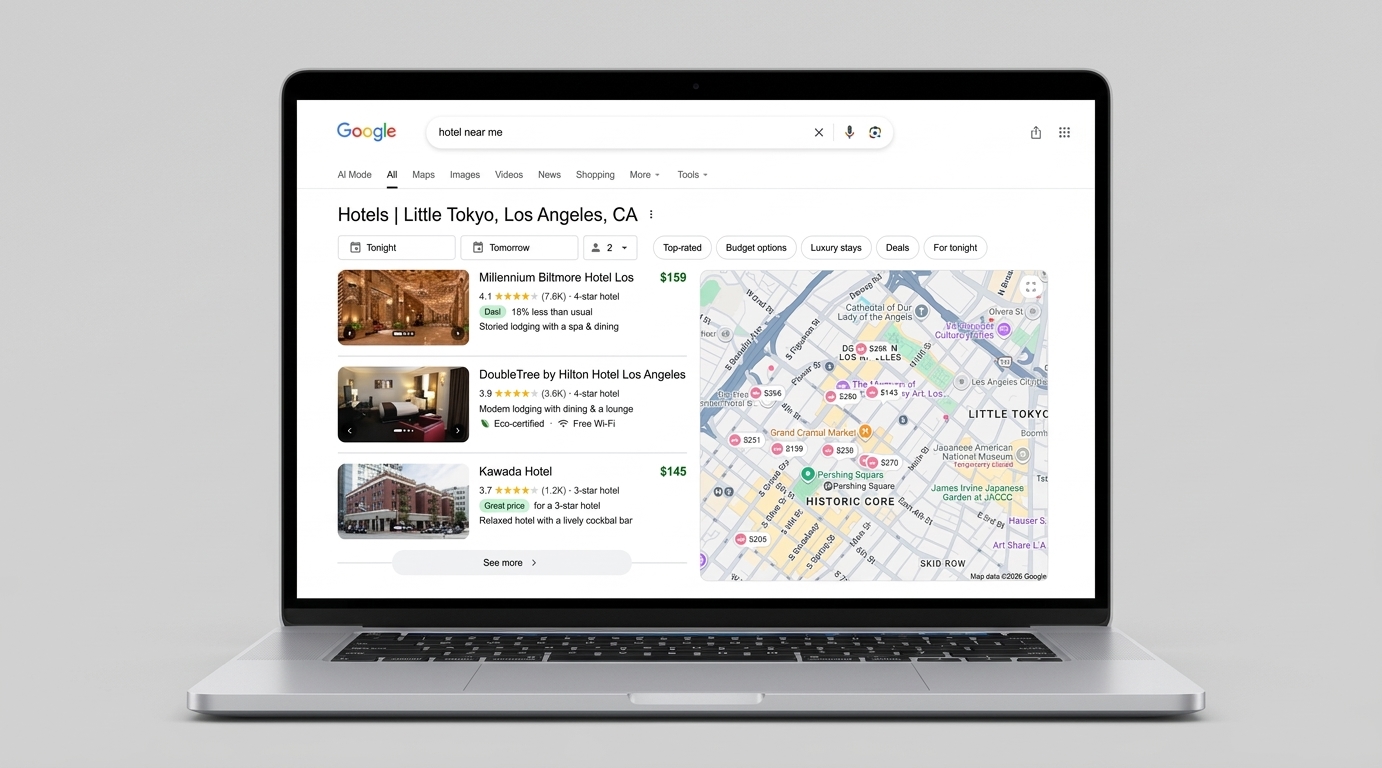
Google Hotel Ads work differently from your typical search ad, and the rules changed again in 2026. If your bidding strategy or feed setup hasn’t been revisited since last year, your campaigns are probably running on outdated assumptions. We’ll break down what’s changed and how to set up your hospitality marketing campaigns the right way going forward.
What Google Hotel Ads Are
Google Hotel Ads are a metasearch product, not a standard text ad. They pull live rates and availability directly into Google Search, Google Maps, and Google Travel alongside OTA rates from Booking.com and Expedia. Travelers see a price comparison module and book through whichever channel offers the rate they want.
Paid Hotel Ads are separate from Google’s free booking links program, which any hotel can qualify for without bidding.
The 2026 Changes to Google Hotel Ads
Google announced that its third-party rates for hotel ads feature will be unavailable after September 30, 2026. Hotels running a direct feed are better positioned right now than those that aren’t.
Hotels without a direct feed will be invisible in Google’s hotel booking module, while OTAs will keep showing up. Performance Max for Travel Goals campaigns continue on Search, Display, and YouTube, but lost third-party-rate-sourced hotel inventory. Google is also folding hotel and travel formats into standard Search campaigns through AI Max for hotels. The migration is still rolling out, and the full mechanics weren’t confirmed at Google Marketing Live 2026.
How Google Hotel Ads Bidding Works
Google Hotel Ads originally offered three pricing models: CPC, Pay-Per-Conversion, and Pay-Per-Stay. Google has since phased out both commission-based models. CPC and tROAS are now the primary options.
Which Bidding Strategy Fits Your Hotel?
tROAS works well for multi-property portfolios with enough conversion history for Google’s algorithm to bid accurately. If your account is new or booking volume is thin, start with manual CPC and switch to tROAS once data builds.
Why Hotels Must Defend Their Brand Name on Paid Search
OTAs bid directly on your brand name, which is why hoteliers should bid on brand name keywords. A traveler searching your hotel name may see Booking.com or Expedia appear above your own site, and a $300 booking through an OTA costs $45 to $75 in commission. Brand bidding gives you a paid-and-organic dual listing that OTAs can’t replicate for your brand, and brand-term CPCs stay low since searches for your specific hotel name carry little outside competition.
How Hotel Ads Compare to OTA Commissions
Expedia Group charges 18 to 22% per booking, and Booking.com averages around 15%, climbing past 25% with preferred placement. A well-managed Google Hotel Ads CPC campaign typically lands a cost per acquisition below those rates, making direct distribution the better deal for luring searchers away from OTAs.
| Channel | Typical Cost Per Booking | Cost on a $300 Booking | Key Caveat |
|---|---|---|---|
| Booking.com | ~15% (up to 25%+ with preferred placement) | $45 to $75 | Rates rise when you opt into promotional programs |
| Expedia Group | 18 to 22% | $54 to $66 | Applies across Expedia, Hotels.com, and affiliated brands |
| Google Hotel Ads (commission era) | ~10 to 15% | $30 to $45 | Commission-based models (pay-per-stay, pay-per-conversion) have been phased out |
| Google Hotel Ads (CPC today) | Varies, typically below OTA rates | Depends on campaign management and booking engine conversion rate | Requires a direct feed, active management, and a converting booking engine |
Direct Feed Setup: What Hotels Need to Do Now
Getting your direct feed live requires three steps. Start by connecting through a Google-certified integration partner or by setting up a Hotel Center account yourself. Once the feed passes Google’s pricing accuracy review, link your Hotel Center account to your Google Ads account. Then rebuild your campaigns from scratch.
Any campaigns built on third-party rates cannot be updated or repurposed; they have to be replaced entirely. Keep in mind that Booking.com and Expedia still appear in Google Hotel results regardless. A hotel without a direct feed goes invisible in that module while OTAs keep showing up.
Best Practices for Independent Hotels Running Google Hotel Ads
Rate parity is where most independent hotels lose ground without realizing it. A solid metasearch marketing strategy depends on this: if a traveler sees Booking.com listing a lower rate than your direct feed, they click Booking.com. Audit your rates regularly across OTA channels and your direct feed to keep them aligned.
- Align your budget to your actual demand calendar and push harder in high-intent windows rather than spreading spend flat across the month.
- Build remarketing audiences from booking engine visitors who didn’t convert, and take advantage of Performance Max reporting metrics to track results.
- Keep your rate feed accurate in real time. Stale or mismatched rates trigger quality penalties from Google, which can suppress your placement without any clear warning in the interface.
How O’Rourke Hospitality Marketing Helps Hotels Run Google Hotel Ads
Running a well-optimized Google Hotel Ads account in 2026 requires consistent attention. Feed management, bid strategy adjustments, rate parity audits, Search Terms monitoring under AI Max: none of these are one-time tasks.
O’Rourke Hospitality Marketing has worked exclusively with hotels since 2001. Our hospitality-focused PPC advertising covers Google Hotel Ads setup and optimization, brand-term defense, and the broader mix of search, social, and email that supports direct bookings. If your direct feed isn’t set up yet, or your current campaigns haven’t been rebuilt to reflect the 2026 changes, that’s a good place to start the conversation.
Final Thoughts on Google Hotel Ads and What Hotels Should Do Now
The mechanics of Google Hotel Ads changed, but the underlying math didn’t. Direct bookings cost less than OTA commissions, and a well-run feed with a brand campaign in place is still the most reliable way to close that gap. Your next move is simpler than it sounds: get the feed live, rebuild the campaigns, and keep your rates clean. Schedule a free consultation with our team, and let’s make sure your hotel is ready for what’s next.